
How to Make Your High Notes Sound Better Without Pushing or Shouting
High notes seem to concern beginner singers a lot because not only are they harder to sing, high notes are harder to sing well. Common issues include throat feeling ‘blocked’ or ‘stuck’, high pitches sounding shrill/shouty/lacking projection when sung.
Below are some suggested solutions for common issues a beginner signer encounters when attempting to sing high notes.
Sing within your usable vocal range
The first thing you need to think about is to make sure the high notes are within your usable vocal range. Find out your vocal range if you have not done so.
Generally, you want to sing three to four semitones below the extreme upper end of your range. That is what singing within your usable range means. That round tone you have in your middle register gradually fades the higher you sing. Your voice sounds shrill and thin when singing at the extreme end.
There is a sweet spot of approximately 5-note range in the upper register that sounds blended, resonant and sustainable. Find that sweet spot and transpose your songs so the high notes fit into that zone. My sweet spot is C5 to E5 (or C4 to E4 if we want to be accurate as to how the male voice is transcribed on the treble staff).
The video above shows the difference between shrill and resonant tone.
I personally use an app called “TimePitch” to transpose backing tracks to suit my voice. I recommend you check it out.
Expand your vocal tract
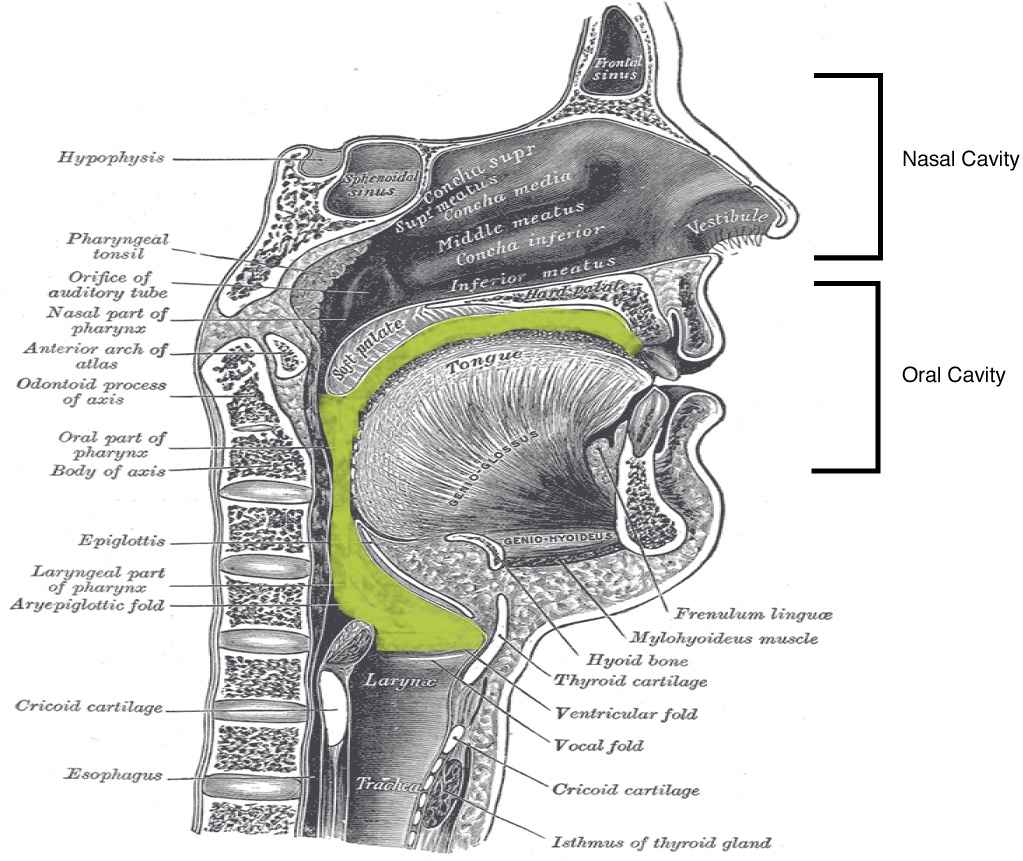
Your vocal tract goes from your lips all the way down to your vocal folds (highlighted in green in the diagram above). This is a flexible tube that can change shapes to make different sounds.
When your high notes sound shrill, it is usually because your vocal tract is too narrow.
The video above shows the part of the vocal tract that needs to be expanded for high notes to sound resonant and round.
The video above illustrates how an expanded vocal tract can give your high notes a more resonant tone.
Manage your breath
How much air do you need when singing a high note? The answer is “just enough”.
The truth is I cannot tell you how much air you need because this is something you need to figure out through trial and error.
Here are some clues:
- If your high notes sound shrill or shouty, you are probably using too much air
- If your high notes sound flat in pitch, then you are likely using too little air
When your breath support is appropriate - meaning your airflow is balanced and efficient - high notes feel easy. It feels like the notes simply come out without being pushed out.
Crush performance anxiety
Many students of mine fear high notes because they fear feeling not being in control of their voice. It is the uncertainty of not knowing what is going to happen.
“What if I’m out of tune?”
“What if my voice cracks?”
“What if it sounds bad?”
This anxiety alone is enough to make singers tense up their throat muscles and use too much breath pressure. Earlier, we talked about how you need to expand your vocal tract and manage your breath to make high notes sound good. Performance anxiety negates both of those things so that even if you have good technique, your high notes will not sound pleasant.
This is where Cognitive Behavioral Therapy (CBT) strategies can be helpful for reframing anxious/intrusive thoughts so you can stay calm, focused and physically-free when singing.
Conclusion
There is no one-size-fits-all approach to making high notes sound better. Our voice consists of many different parts that need to work holistically for optimum function.
Focus on one aspect at a time and allow your technique to evolve gradually. Eventually, your high notes will become more consistent, resonant and enjoyable to sing.
FREE Ebook: How to Go From Shower to Stage
Discover the 3-step system to gain control of your voice and sing with confidence in public (even if you only ever sing in the shower)
By submitting this form, you agree to receive email messages from Top Singing Secrets (Benny Ng). Your email address will NEVER be shared or sold. You can unsubscribe easily at any time. See our privacy policy for terms and conditions and to learn how we protect your data.

Since 2011, I've helped countless beginner singers go from shower to stage.
Will you be one of them?